Thursday, January 30, 2025

The Hardest Player To Please Is Yourself, Part 1: Game Hoard

 Intro


    I have a small issue - which is to say, a zine. Get it? Hah! That's it folks, that's the article, see you next week.

    OK but actually - in 2024, I engaged with the work of two creators who would make me finally look at a kind of TTRPG I'd avoided up to this point, and in doing so lead me down a roughly year long collecting spree which is finally starting to pay off as I move from just planning on playing games into actually playing them: that is to say, Tatiana Gefter's fabulous work on the podcast Soul Operator which is a dramatized playthrough of A Yolland's Welcome To The Habitrails, and Sam Leigh's game Death of the Author. Both Habitrails and DotA (no, not that one) are tarot-centric solo journaling games which prompt you to respond to your card draws, but both in vastly different ways. When I was waiting around for Death of the Author's crowdfunder to fulfill, I decided I'd pick up Habitrails and another game I saw advertised a lot, Pandion Games' Whisper in the Walls 2e, for some Halloween fun. Whisper is also a card-based prompt game, but it uses a standard deck of playing cards which you prepare - and has 2d6 and d66 tables. And only then did I remember I'd actually seen another game that used a deck of playing cards - a game that I'd bought during the adrenaline rush of the ENnies in 2022 which had become a very nice shelf decoration but I'd only read a bit through - Nich Angell's Colostle, which uses the standard deck of cards to build prompts but ALSO has character classes and biome-based travel tables and suddenly I realized there was a lot more to all of this solo RPG stuff than I'd actually understood at the jump.

    In the intervening months since backing Sam's Death of the Author crowdfunder, I have amassed 19 games which are all intended for solo play directly out of the box rather than requiring 3rd party mods to turn them into solo games. I say that not as a dig at any game that has had a fandom strong enough to build an aftermarket solo mod for a game, I just mean that the market for solo games is by no means a small one. Likewise, some of these games are additionally intended to be played as duet games, or 1v1 player vs GM games, or even full party GM-less games. There are all different kinds of oracle methods, as well as all different kinds of actual playstyles to go through. In the interest of cataloging this backlog, and also making an attempt to make a sortable list for myself, I'm going to arrange these games into a lightly annotated list with pictures and first impressions so that not only do you know what I have out there, but I can also just roll a d20 and pick my next game to play pretty easily so that I actually play them rather than just hoard them because BOY HOWDY have I hit decision paralysis mode.

    I should also say - while I have these 19 physical games, to keep this a nice round 20 I'm including a lone bonus in-production solo game that I will absolutely buy once it exists in the physical world. Also, please know that these first impressions below are in almost all cases from a brief flip through - if I flagrantly miscategorize a game, please tell me, but also know that I'm sure I'll learn about it as I play it.

A d20-Rollable List of Games


1. Colostle, by Nich Angell
  • Needed to Play: deck of playing cards, something to record your story, optionally the character sheet included at the back of the book
  • Genre: adventure, robot fantasy
  • Play Modes: Solo only.
  • First Impression: Infinity Train, but make it D&D. This book is fucking huge. Most solo games are zines, at least as far as I've seen, but holy shit this thing is big and thin. Very simple character sheet, example of play seems pretty straightforward, seems like there's a lot of contextual tables for how you progress through the world.


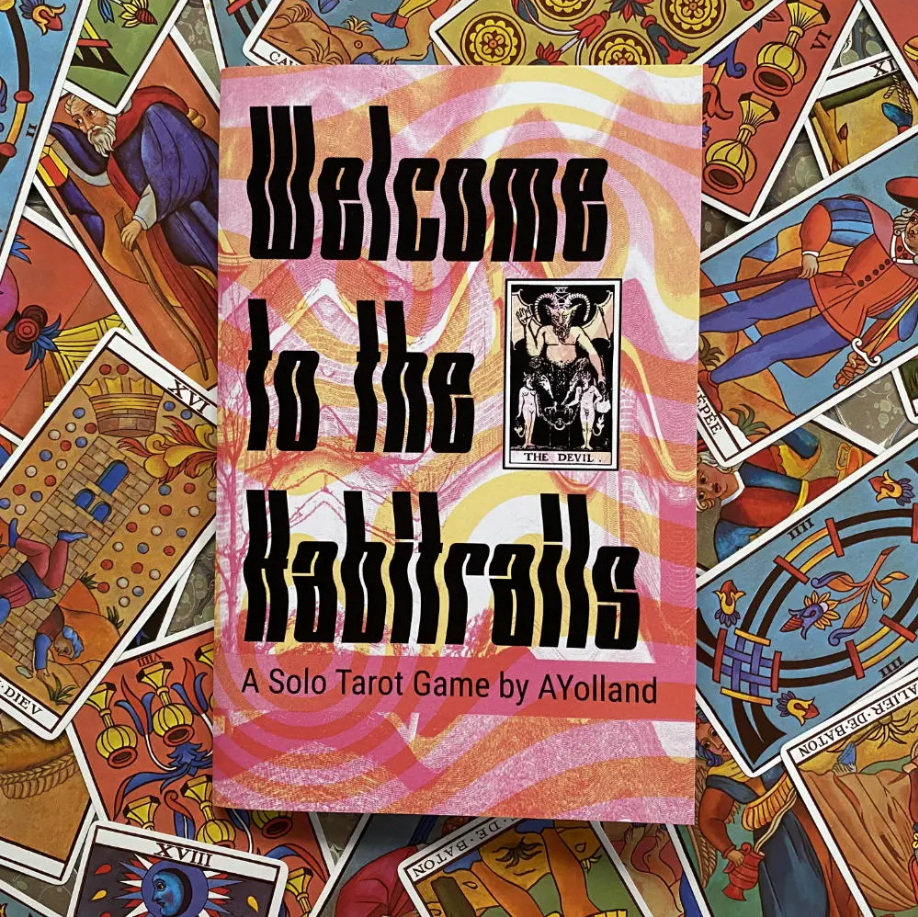
2. Welcome to the Habitrails, by A Yolland
  • Needed to Play: tarot deck, something to record your story
  • Genre: various flavors of horror, sci-fi
  • Play Modes: Solo only.
  • First Impression: So this is cheating because I did actually begin a playthrough of this but also I've heard the first batch of episodes from Soul Operator so like I know what the vibe is, but for completeness' sake - this is a game that is gonna keep making things get weirder for you in a frog-in-the-pot-of-boiling-water kind of way.


3. Death of the Author, by Samantha Leigh

  • Needed to Play: tarot deck, something to record your story
  • Genre: any, though with a Frankenstinian lens
  • Play Modes: Solo or Duet.
  • First Impression: one of my favorite movies is "Stranger Than Fiction," one of Will Ferrell's only slightly serious movies where he realizes he's a character in a story and his author is going to kill him. This feels kind of like that.


4. Anamnesis, by Samantha Leigh

  • Needed to Play: tarot deck, something to record your story
  • Genre: self-discovery, potentially horror
  • Play Modes: Solo only.
  • First Impression: I feel like amnesia as a plot point came up a whole bunch in the 90s and 00s in most of the media I consumed - like, amnesia and quicksand were the two biggest concerns of my childhood. Thankfully I've had to deal with neither of them - but this does at least let me simulate the process of amnesia and self discovery, and I think that's a pretty valuable skill to exercise. Unclear if there's a hard mode that involves speedrunning before you sink into a pit of quicksand, but I'll check back and let you know.


  • 5. The World We Left Behind, by Samantha Leigh

  • Needed to Play: standard deck of playing cards you're willing to besmirch, a besmirching device such as a fine-tipped marker, 1d6, something to record your story
  • Genre: exploration, introspection, sci-fi
  • Play Modes: 1-5 players GMless
  • First Impression: So this project has already had a ballet with a chiptune album score based on it, which fucking rips. But also, the idea of "ruining" a deck of cards as you play is quite interesting to me because while I am loath to alter any game through play (this is why I haven't played much of Yazeba's B&B T_T), I think there's a really interesting conceptual link between the idea of exploring the ruins of a civilization on a planet and then leaving your own mark on the world as you do so. That's just a fascinating thing to chew on.


  • 6. Thousand Year Old Vampire, by Tim Hutchings

  • Needed to Play: 1d10, 1d6, something to record your story
  • Genre: historical vampire fiction
  • Play Modes: Solo or multiplayer GMless
  • First Impression: What a beautiful object. This book is probably the most beautiful TTRPG object that I own, if not the most interesting and beautiful book I own in general. In terms of play, I find it extremely fascinating that it encourages both quickplay and like full journaling situations.


  • 7. My Mother's Kitchen, by Fleit Detrik

  • Needed to Play: tarot deck, 1d12, sticky notes/note cards/scissors/tape, something to record your story in
  • Genre: familial joy and trauma, fulfilling an oath
  • Play Modes: Solo only.
  • First Impression: This is also an amazing object. This is also a game that very much encourages you to physically create and then destroy things which is nice since they are not inherently game objects. As someone who lost their grandmother back in 2020, who was incidentally the person who taught me how to cook, I imagine I'm going to have a lot of emotions about this game.


  • 8. Grotten: 1-Bit Deeper, by Tommy Sunzenauer

  • Needed to Play: 2d4, 2d6, 1d8, 1d10, 1d20 (fuck d12s, all my homies hate d12s), something to record your character sheet, and either printing out the tiles for the maps and monsters or some graph paper to draw your dungeon in
  • Genre: oldschool fantasy dungeon crawling
  • Play Modes: Solo, or 1 player with a GM
  • First Impression: I ran this as a GM with a buddy of mine a while back and it worked remarkably well. In the way of many old adventures, I feel like it leaves a lot of space for you to project a story on to but only giving you a few things set in stone, which is neat. You'll get out of it what you put into it.


  • 9. Lighthouse at the End of the World, by Ken Lowery

  • Needed to Play: a standard deck of cards, 1d6, a coin, a Jenga tumbling block tower, 10 tokens, any map that contains at least one hemisphere of coastlines, something to record your story in
  • Genre: nautical existentialist horror
  • Play Modes: Solo only.
  • First Impression: Look, as a certified Slut For Sea Shanties, giving me Age Of Sail stories of ghosts and isolation and introspection is basically laser targeted at my sensibilities. 


  • 10. No-Tell Motel, by Ken Lowery

  • Needed to Play: a standard deck of cards, 1d6, something to record dossiers about characters and the room ledgers 
  • Genre: murder mystery
  • Play Modes: Solo only.
  • First Impression: God I love murder mysteries. Solving mysteries is extremely hard in TTRPGs in general - it's one of the reason I like the Brindlewood Bay/The Between approach to doing it since you never feel stupid while you're playing. I'm curious to see how this set of rules plays out, it seems very well thought out.


  • 11. Eleventh Beast, by Exeunt Press

  • Needed to Play: paper/notebook to sketch on, 5d6, 1d8, a standard deck of cards, three kinds of tokens, and a map (either included or printable) 
  • Genre: monster hunting historical horror
  • Play Modes: Solo only.
  • First Impression: This also blows my mind as a combination mystery solving and monster hunting game. You also end up creating a little monster hunter journal, which I think could be a cool prop for other things.


  • 12. Caveat Emptor: Expanded Edition, by Exeunt Press

  • Needed to Play: something to record your story, 3d6, a standard deck of cards, 3 tokens to go along with your curse tracker
  • Genre: Needful Things
  • Play Modes: Solo only
  • First Impression: Look, you had me at "Needful Things: The RPG," but the added bit that you're actually working for the Devil and thus are encouraged to do well at Cursed Capitalism or you get obliterated is extremely funny to me. This probably says a lot about who I am as a person, and that's unfortunate.


  • 13. Blood Borg: Loser, by Adam Vass

  • Needed to Play: the base Blood Borg rules, a standard set of RPG dice plus a coin or d2 and d3 if you're fancy, a character sheet, something to record your story if you want 
  • Genre: punk-ass vampire shit
  • First Impression: God this zine is oozing with style. Or blood. Or both. I know this bends my rules a bit since technically the solo rules are in a zine separate from the main rulebook, but also, shhhhhhhhh. I love the idea of the solo mode basically being the "it's time to get the band back together for a job" except the band is a bunch of other vampires who probably hate you, the job is presumably killing people for fun and sport, and you'll need to outrun cops and monster hunters. Also you can summon weird little guys to help you!


  • 14. Dark Fort, by Pelle Nilsson

  • Needed to Play: one of the provided character sheets, 1d4, 2d6, something to record your story if you want 
  • Genre: oldschool minimalist dungeon crawling
  • First Impression: seeing a micro-zine like this is honestly super inspiring as a game designer, because you can really just see the absolute distilled essence of a game that then would spiral out and become something bigger. I'm looking forward to an afternoon as Kargunt!


  • 15. Last Oath, by Lucas Rolim

  • Needed to Play: 1d6, 1d20, something to record your story + a copy or sketch of the included map and character sheets
  • Genre: dungeon crawling choose your own adventure
  • First Impression: I know someone told me that there used to be a book series of choose your own adventure games that were also solo D&D or D&D-style adventures. This is that, but with the intent and assumption of multiple playthroughs. 


  • 16. Kal-Arath, by Castle Grief

  • Needed to Play: d6, something to record your story and character sheet on, a hex map (or equivalent) to chart your world.
  • Genre: weird classic pulp fantasy
  • Play Modes: solo or with friends!
  • First Impression: So I got this along with its two companion zines as a part of Castle Grief's crowdfunder. I've looked through them and I've gotta say it's pretty cool to have something that you CAN play as fully solo, or with friends using the oracle and random rolling to generate the map, and it doesn't SAY you can run it GM'd but it also doesn't not say it. It's a very vibes-based way to storytelling a weird fantasy world that I think is neat. Excited to see how it plays!


  • 17. HUNT(er/ed), by Dillin Apelyan and Meghan Cross

  • Needed to Play: for solo, 3d6, a standard deck of playing cards, a piece of paper, a token, and something to record your thoughts. For duet play, increase to 4d6. You can also replace the dice/paper/token with a hook and ring game.
  • Genre: undiscovered kink revealer, monster hunting
  • Play Modes: solo or duet!
  • First Impression: Whereas the duet version pits monster against hunter, the solo version of this game has you play someone not quite monster, not quite hunter, but definitely all conflicted as you move through accepting or denying who you are. The fact that the alternate play mode involves something sold as a drinking game which therefore means you could turn this into a drinking game for yourself or if you play it duet is ceaselessly fascinating to me. 


  • 18. Endling, by M. Allen Hall

  • Needed to Play: 2d6, a deck of tarot cards, a token, an included hexflower map, something to record your progress
  • Genre: Apocalyptic survival
  • Play Modes: Solo only.
  • First Impression: This is, again, a beautiful object. It looks and feels like an old government manual, which I suspect was the point. This is also a game that I suspect will make me deeply, existentially sad while playing, which is to say that is is exactly my shit.


  • 19. Whisper in the Walls 2e, by Pandion Games

  • Needed to Play: a standard deck of playing cards (with jokers! wow!), 2d6, something to record your story if you want 
  • Genre: horror, exploration
  • Play Mode: Solo only
  • First Impression: In a very real sense, this appears to be a haunted house simulator. That in and of itself is pretty fucking cool, because while I know some very talented VFX artists who have made some very gruesome costumes, and I know some haunt actors who are very good at scaring people, truly nothing is scarier than the things your own mind can summon against you.


  • 20. Sin-Eater, by Anica Cihla

  • Needed to Play: candle, 2d6, something to write and sketch on, coins, included ritual mat
  • Genre: This is just what I assume it's like to go to a Catholic church service. No, I have never been to a Catholic church service, why do you ask?
  • Play Modes: Solo only.
  • First Impression: If the physical release of this game doesn't bleed when you open it, frankly I don't see the point in owning it. Speaking of bleed, this is a game that at a quick glance does more than most of the other games to force you into the life of the sin eater you are embodying. This is a game of rituals, and it is only a matter of time before it is your last. I suspect a proper session of this game is going to involve some emotional detoxing after, which is fine - but the use of ritual to bind you into the character rather than just having prompts and asking you to reflect upon them is...spicy. I will have more things to say about this later.


  • Outro

    So, some quick fun numbers:

    • roughly 25% of these games are dungeon crawlers
    • roughly 35% of these require a standard deck of playing cards
    • roughly 25% of these require a deck of tarot cards
    • roughly 50% of these are explicitly horror games, while the rest are mostly just implied horror through the background radiation horror of adventuring or self discovery
    • only one of these dips into Wretched And Alone territory - that is to say, uses a block tower
    I just think that's neat! Anyway, while the purpose of this blog isn't really to do reviews, I do think I'll post play reports for these as I make my way through them - engaging with games both in play and to understand authorial intent absolutely is within the purview of this blog, and I hope you'll enjoy them as much as I think I will too.


    Wednesday, January 8, 2025

    Creating Mathematically Average Challenges

    Understanding Averages 

    Helps You Build Challenges

    As An Adult, I Suck At Math

        When I start talking about numbers, I like to tell people that in college I got an English degree, and that means you legally can't make me do numbers anymore nor can you make me read any more books. This is, of course, a lie, because as I was reminded last night I have been playing roleplaying games for almost two decades and have not yet found a way to escape numbers or reading books. Being trapped as a Forever GM for most of those years led me to learning very niche applications of math insofar as they help run challenges on the fly - because no matter what the system is, you can justify whatever the dice are doing with whatever fluff you need to but at the end of the day you need to know what the dice are doing so you can move on. I would like to impart some of that knowledge to you.

        A quick word of warning: The things I am about to tell you are mathematically true, but if you are a math person you will likely be unhappy with the way this information is presented because I talk about Numbers the way Word People talk about Numbers, not the way Number People talk about Numbers. I'm also not talking about ways to build narratively interesting encounters here - there are many, many more eloquent and intelligent people on the internet who've beaten me to the punch on that one. What I am to do here is to equip you with a set of tools that will hopefully allow you to improvise challenges in games that require dice-based number generation such that it can be as on-the-fly as your regular cool story improvisation is.

    Finding Dice Averages Quickly

        This is not secret knowledge, but just so it's here to reference: the average roll of a single die is [biggest side]/2 + .5. The average roll of two dice can be found by adding the largest and smallest sides of that die together. So, for example, the average roll on 1d6 is 3.5, whereas the average on 2d6 is 7. My mental shorthand works like this: If I need to find the average damage on a 3rd level Fireball in D&D 5e, I look, see that it's 8d6, and that means on average it's 4x7 since [2d6] as a variable is the same as 7. Likewise, if I was playing a Paladin two-handing a longsword with 16 STR using a 2nd level spell to power a Divine Smite, then I know that the damage is 1d10+3d8+3 (assuming they're not fighting an undead or fiend) which means that the average roll is 5.5+(4.5+9)+3, or 22.  That's all well and good for practical applications for players, but where does that help you as a GM?

        (As an aside, you can use this guy to do averages on your regular D&D polyhedral dice. If you're one of those sickos out there playing Genysys with those wacky symbol dice...good luck man, this post is mostly not for you, I haven't had time to review those rules yet. Sorry to all my Campaign: Star Wars and Skyjacks homies out there.)

    An Average Challenge

        So keeping with D&D for most of its iterations and derivatives, we know that a stat score of 10 is supposed to be the average - narratively, that means that anyone at a 10 is assumed to be just about as good as any random person in things related to that ability, but mathematically what that means is that there is no modifier to a roll. If we pop back to the above and see that the average roll on one die is half of its size +.5, that means that a challenge with a DC of 10.5 would be average, or in other words, if someone is assumed to be average at something, it means they're going to succeed at doing it a little over half the time. I'm sure there's a better way to put that, but this is the thesis which we're going to be using moving forward: an average challenge is one that a character is assumed to succeed at doing a little over half the time.

    5e (2014 edition)

        Now, the reason I keep bringing up D&D is of course because this was a concept I needed to understand while working on One Night Strahd. My co-author, Jake, is in fact a Numbers Person, and just does all this stuff in his head. I, as we have established, am a Words Person, and so I ended up having to write this out so I could interact with it properly. Now, 5e has a lot of variables that come into play which makes people think that balancing challenges is hard - commonly, I hear stories about how "oh, this one character is OP and therefore either I make my encounters challenging for that character and that means nobody else can interact, or I make it challenging for the other players and that character can just mop the floor with it." Now, setting aside the fact that many other games solve the problem of this level of balance granularity by simply not giving a fuck about it (see: much of the OSR scene, much of the narrative game scene, etc), if you need to know if a dice roll of any kind will be challenging to a character at any given level, I have constructed this table which takes into account proficiency bonus and stat score in a given level range, but does not take into account any spells or abilities that add on an extra die - but with that said, using the theory listed above, you should be able to figure out how that changes the odds. (It also doesn't take Advantage or Disadvantage into account. Mathematically, I have always counted Advantage as a +5 bonus and Disadvantage as a -5 bonus on a roll based on this post from 2012 and this post from 2014, so while I assume that in other systems it would be a 25% change up or down as well, I don't actually know the math and I'm not confident enough to account for it in any of the following parts of this, so just...like...take care of that yourself if it matters to you.)


        The other way to say what this table does is this: if you set a target number for a challenge, consult what level the character is at, then see where that number falls - if it's closer to a number on the left side of the table, it'll be easier, and if it's on the right side of the table it'll be harder. The reason this table has Proficiency Bonus included is, of course, because if you're rolling for something you're not proficient in, your bonus to it would never change, so if you somehow had a 0 in something and were rolling for it you'd always be at a -5, if you had a 10 you'd always have no bonus, and if you had a 20 in the stat is would be at +5, meaning that the control numbers here are 5/10/15, respectively. 

        With me so far? Let's try this out with a different game.


    2d6+Stat Games (PbtA, etc)

        Systems that only use 1 or 2 dice at a time make this a whole lot easier to calculate - and it isn't lost on me that many of the games that use this system to resolve mechanics are often more narrative focused and thus don't have as much emphasis on trying to Make Number Go Up. Broadly speaking, in a lot of these systems, if you know you've got a negative bonus to a stat, you know that it's something you're not as good at, you're roleplaying that, whatever. There's a lot of ludonarrative consonance there. But for the sake of math let's see what this looks like for games that only let you have a -1 to +3 to your average 2d6 roll. (Again, not taking Advantage/Disadvantage into this because I am Math Stupid.)


        Knowing that PbtA games generally follow the rule of 6- being a failure, a 7-9 being a partial success and a 10+ being a critical success, I actually find this to be more numerically interesting than in a binary pass/fail system like D&D because now you can see that on average rolls, characters will almost always succeed with a cost on average, with only the truly penalized or specialized getting into the next tiers on average. I think there's probably a lot to chew on on the idea that a binary success/fail game like D&D considers an average challenge one that a player will succeed on a little over half the time whereas a more narrative system like the Powered by the Apocalypse family of games consider an average challenge being one that the player will succeed at a cost, but this post is already getting in the weeds. Suffice it to say that you can extrapolate data like this out to other in-game meta-currencies that allow you to push success up from Failure to either Mixed or Critical successes. (This in particular is something that makes the design choice in The Between so interesting re: Masks and other abilities that function as Masks in certain situations tasty choices to consider when selecting your characters, but that is perhaps a ramble for another day.)

    Applying These Concepts To Other Systems/Challenge Designs

        So, without trying to detail every possible combination of mechanics, how can you apply these principles to designing challenges in whatever game you're designing for?

    1. Figure out whatever Average looks like for your game - as in, the lowest possible number that you can generate based on stat modifiers and dice you're using, the highest possible number using modifiers, and the midpoint which should be what a roll with no modifiers looks like.

    2. Figure out what you want Average to mean, narratively - do you want Average to just mean success? Do you mean Average to mean success with a drawback?

    3. Compare your player characters' stats against the numbers you have set for your challenges - if the challenge target numbers fall farther towards the left of the distribution, the players will be less challenged, if they fall farther to the right the players will be more challenged.

    4. You can do this on a character by character basis (or even stat by stat!) in order to test how challenged by certain parts of your challenge certain parts of the party will be (say that five times fast). When getting into the nitty gritty of design, especially for Published Adventures (TM), this can really be helpful when trying to gauge what kind of power level the adventure is. I find this to be much more useful information, especially when dealing in the world of D&D because the balance of a character is often more dependent on the proficiency of the player building the character and the availability of in-game bonuses than it is on the actual numbers derived from each level.

    And there you have it! So simple a particularly disgruntled baby could do it. Have fun!

    Thursday, December 26, 2024

    Why Are You Like This?

    INTRO

    It's probably time to elaborate on the question I'm trying to find some answers to with this blog instead of just vaguely yelling about it on BlueSky. This might be a little bit of a ramble, and in a right and just world this would be some kind of sexy three hour long video essay, but just bear with me here because to start off with I'm going to talk about how I'm tackling what might just be the most important question in all of TTRPG fandom:

    "Hey Man, Why The Fuck Are You Like This?": The Preamble

    In this case, the "man" in question is a catch-all for "a person who tries to shoehorn their favorite game, usually Dungeons & Dragons, into fitting any kind of genre or playstyle" and "like this" refers to "doing the thing I just said instead of finding a game already suited to tell the story you're trying to tell." To answer that question, I need to tell you a little story about myself so you know how and why I'm coming at this question. (If you just want to skip to my thesis, CTRL+F "Hey Man, Why The Fuck Are You Like This?": The Thesis.)

    So, I started my RPG life in my late teens circa 2007 playing D&D 3.5. Dungeons and Dragons was, with probably two exceptions, the only roleplaying game I played or knew literally anything about for almost 15 years - except for a very brief stint playing what was probably the first edition of Rolemaster  with some of the grognards at my FLGS and the fourth edition of Hero System with some older college friends, D&D 3.5, and then 5e, were the only games I knew anything about. They gave me everything teenage and early-20s Adam could want - solving mysteries one fireball at a time, killing monsters one fireball at a time, ignoring the Geneva Convention one fireball at a time - you know, the classics. Sure, I knew about stuff like Vampire: The Masquerade, but that was for "those weird LARP kids," and the one time someone invited me to play Fate and tried explaining how FUDGE dice worked I laughed at him until he never talked to me again, all according to keikaku. 

    I was just out of college when 5e came out. The jump from 3.5 to 5e was a drastic one, but one that felt good at the time - I had lost the inclination to comb through seven thousand illegal PDFs to min-max my build now that I was a Real Adult and had Real Adult Time Constraints, and plus the wonders of a bounded target system meant that I no longer had to make number go up good - I could just play the game! Heck, the prestige classes had gotten rolled into the base classes so I didn't even have to worry about that much balancing of theming versus CharOp at all, I could just roll and go! What a miracle! Suddenly, all of the people still clutching to 3.5 or, worse, PATHFINDER, seemed like such buffoons! Could they not see the glory of the simplified but just as flavorful builds of 5e? What do you mean there "aren't a lot of options" here - there's so many choices to make that suddenly seem meaningful rather than "this makes my number go up by +1, which allows me to take this other feature"?! No more did you have to have to agonize over how to make a particular set of numbers bigger so that your character could be "good enough to play," you could just choose themes and go! Well, except for playing a Ranger, that was just bad. And then there was also trying to recreate the things from 3.5 that didn't get ported over. And then of course there were the themes that weren't covered that would have to be compensated for. And oh hey would you look at that, there's a funny interaction between how Warlocks regain their spells and Sorcerers' Spell Points and Paladin Smites, isn't that interesting? I bet you could make a really killer build like that and OH GOD IT'S HAPPENING AGAIN.

    And so I continued on this way until my friend Jake, whomst I had met back in the heyday of D&D 3.5 CharOp, asked me to help him break down one of the more popular 5e modules to run over a single Halloween for our friends. Jake, someone who had Worked In Videogames and Was Good At Numbers and Had An Addiction To Boardgames, is much smarter than me - and working with him in actually breaking down and writing a module was the first time I actually had to think about how games worked. Sure, I'd DM'd games for ages at this point, and I usually did my own homebrew worlds - but I never, like, peeked underneath the curtain to understand how games functioned at the molecular level. Things like user experience while reading the book, or having good props, or really even considering the other people playing the game with me outside of the fact that they were my friends - we all trusted each other to know the rules, I trusted them to make their own little murderblorbos and they trusted me to give them an engaging story which allowed them to commit righteous violence against the unjust. What more was there to it, I thought? As it turns out, quite a lot.

    By being forced to consider the actual gameplay experience of other players rather than just going on the baseline assumption that "we're all here to play the game we know with people we like and that's good enough," I began to find that really, there were a lot of things we wanted to do with the story that really just didn't exist within the confines of Dungeons and Dragons. Like, yeah, you could roll your skill checks or whatever, but what happens when you remove the ability to do that? One encounter involved having to puzzle out how to get past a Prismatic Wall, either via deciphering the clues to each layer or literally murdering a companion to get a rod to nullify the spell, and then chatting with a vampire to peel back the layers of what was really going on? (I designed the puzzle half of that, the latter half was all Jake.) Or take, for example, my alternative to having to wade through endless random encounters by instead having little narrative vignettes and expending resources to pass through the castle? Like, technically, legally, these things existed within the framework of D&D but they were not quite what you'd expect to sit down and do at a lot of tables. This was the first time I really ever considered the idea that you know actually it's quite possible to offer a different kind of experience with that game - but of course, I would never use a different system to tell this game, right? It's still D&D baby! This is still a D&D story, so obviously if something is missing from D&D to complete the experience I can just add it on. Or like change some stuff. That's still D&D right? Obviously. God I'm so smart, wow. I'm the only person to have ever thought of this. Except, y'know, for Jake, who has been teaching me about all of this while we do the design work. But other than that, wow.

    Fast forward to 2022 - I'm at GenCon, I'm fumbling an acceptance speech for the game Jake and I did, and now I'm exposed to all these other games. ALL THESE OTHER GAMES? Why are there so many games! There are studios I know from their days writing D&D 3.5 content - Green Ronin, Monte Cook, Goodman Games. There are writers around who I...also knew from their D&D content, like Keith Baker. But what's this? Oh right, Chaosium! Those Cthulhu guys! That's a game that exists, sure, I know that one! But then what's this? A...game about collecting sea shanties that requires its players to sing and resolve conflict within the bounds of the song? A game that's kind of like Infinity Train but you play it...alone, and also instead of a train there are castle robots? A game where you...are animals and you go on a journey I guess, but the story is found more in the interaction between the players rather than what the GM has to say? And why do people keep describing their games as running off apocalypse power?

    "What the fuck are these people doing out here?" I thought. 

    I was 31 years old, and it was about time I learned what there really was out there.

    What followed could only be described as a "certainly not to be used to diagnose any flavors of neurodivergence" amount of diving into consuming other games media. I had listened to a few actual plays by this point, all of which had played a critical ro- extremely vital part of being able to rapidly understand how other games worked - sure, all my favorites were doing D&D, but I also got some Monster of the Week in there, and there was that show about sky pirates my friend kept trying to get me to listen to that used some Star Wars game with weird dice as a baseline, but beyond that I really hadn't ventured out. I know I've been making joking and oblique references here but credit where credit is due, the One Shot Podcast (then hosted by James D'Amato and now hosted by Dillin Apelyan) and the Party of One Podcast (hosted by Jeff Stormer) were absolutely instrumental in onboarding me to the wider world of TTRPGs. By being able to listen to actual games being actually played, without having to spend the time learning how to run them/begging my friends to branch out into something new/have to have the mortifying ordeal of being known and go make new friends, I could just go to a booth at a con, look at a game I thought was cool, then go find an example of people playing it and see how a session might go. AND some of these podcasts included interviews with the creators so you could understand the design process? Absolutely mint. 

    I've spent the better part of two years making up for the almost two decades suckling the teat of dragons that may or may not be in dungeons. I've bought way more games than I've read, and thanks to the combined power of ADHD, being able to comprehend podcasts played at double speed, and jobs with a lot of off-the-phone downtime, I've probably listened to more hours of games being played than I have ever played myself. I've been in some actual plays, I've written some other things, and most importantly, I have talked to other people who are also interested in games. With all of this in mind, I think I have a workable thesis to answer the question:

    "Hey Man, Why The Fuck Are You Like This?": The Thesis

    If I had to boil this down to the absolute smallest concept, I think the root cause of why people are like this is because of the sunk cost fallacy, but like a fractal version where every time you examine what cost is being sunk there are even deeper costs which continue to sink into others. In slightly more dramatic and less legible language, I believe this fallacy to have three core pieces - A Trifarce, if you will.

    Piece 1: If the game that someone likes takes a long amount of time to master, they will assume that all games take a similar amount of time to master.

    Piece 2: If someone has spent a long time mastering a game, the idea that spending time to master another game will simultaneously invalidate the time they spent mastering the game they already like, and also mean that they won't be able to have fun with the new game until they've spent at least that much time.

    Piece 3: People don't want to spend time mastering something they're not sure that they will like, and if their only choices for telling a new kind of story are "master something new" or "reshape what you know to fit," they're going to take the easy route.

    The fourth piece of The Trifarce - the missing bit in the middle of the three other triangles - represents everything that is missing that would cause you to grow: a community of peers rather than a group that expects you to be the subject matter expert; the knowledge that things can be any way other than how they already are; ideas that are not your own that challenge your own expectations.

    I have one final story about me to drive this home - the day that I stared into the hole in the middle of The Trifarce and decided that it was time to fill it in. (Hah! You thought skipping the preamble would get you out of reading a story? Fool that you are.): 

    Shortly after Jake and I wrote One Night Strahd, an offhanded comment he made about a setting with vampires and riverboats took hold of my mind. In his mind it was some kind of a Berlin Wall + Vampires story, but in my mind I saw a generational survival horror game where players controlled not one character but many - and while the general plot of the game would be mapped out, the players would find ways to have their stories of grief and loss while rebuilding society. But, y'know, on riverboats, and also there are vampires, and it's still a fantasy world. A year or two ago, I got some friends together to playtest this - but I had them make D&D characters, because at that point I was still basically convinced it could be just a really advanced way to tell stories inside of D&D like we had done with ONS. It was a story about violence, yes, but more importantly it was a story of community & survival, of amassing resources and unlocking further character options down the path. What I found was that despite being told all of this, the players still treated it like a D&D game. One player refused the premise of the prompt for the session completely - he had spent hours coming up with his character and his backstory and couldn't think of a single reason why his character would engage with the plot as presented. Another player just couldn't buy into the game and kept doing silly things to pass the time because there wasn't enough combat - and then was confused when combat did happen because they were level 1 characters up against full strength vampires. Despite being given a dynamic and interactable world, the players kept looking at their character sheets for answers on how to survive, because they'd spent so much time building these characters, and then were upset when some of them died because if they couldn't beat the creatures in the encounter, why did I even bother running it?

    Had I known then about the Six Cultures of Play, perhaps I could have explained the premise better. If I had known about Ars Magica or Yazeba's Bed & Breakfast at the time and could have articulated that I was trying to create a game ultimately intended for either doing Troupe Style play (like AM) or Ensemble Style play (like Zeeb), maybe I could have better articulated the difference in character creation philosophy. If I had played literally any of the OSR/NSR games like Down We Go or Into The Odd I might have been able to articulate that yeah, your characters have abilities, but you should be looking at the world for inspiration on what to do in the moment, not on your character sheet. If I'd played Monster of the Week or The Between before then, maybe I could have explained the idea of defining what you want to do first and justifying it with an ability/move afterwards. But I didn't know any of those things then, and so I was unable to express myself, and nobody had a good time - but it drove me to learn, and I have not stopped. And that missing drive is, I think why so many people remain "like this" - without the drive to improve and look outward, you instead retreat inward and just keep digging yourself deeper into a hole. (And, like, probably spend way too much time writing your own fantasy heartbreaker that just ends up being D&D But Worse But This Time It Has A Thing You Like In It to release along with the eleven thousand other iterations of that each month.)

    If you made it this far, you're a real fuckin' champ and I appreciate you. In addition to the aforementioned James D'Amato, Superdillin, and Jeff Stormer for their superb actual play work, I'd like to shout out Jay Dragon, Geostatonary, Quinn Morris, assorted other humans in the Possum Creek Games Discord, Tony Vasinda and the Plus One EXP crew, as well as my other friends in my Very Secret Book Club - at some point in time, something you've done, something you've said, or some time you've spent being willing to humor my ramblings has helped shape the ideas that I could not yet give proper form and I am made better by knowing you. 

    Part 2 of this series will not be anywhere near as long or as unhinged. It will be short, there will be hinges. Like a pet door, or a very small cabinet. But while this post focused on WHY people are they way they are, the next one will be about the implications of that and how that manifests.

    Wednesday, December 11, 2024

    The Post-PAX PAX-Packed PAX Post (Unplugged 2024)


        Long ago in my previous life as a chiptune music blogger, I used to be the social media person for MAGFest's mini-stage at PAX East. In addition to my MAGFest duties, I would take some time to go chat with developers, play some videogames, and generally just absorb the culture of the event after which I'd write up an article about what I saw and played. With the return of my blogging life, I feel it only appropriate to revive this article series to fit my new form, though this time around there wasn't so much schmoozing and playing games as there was running games and...running games. So maybe this also kinda counts as a review thing? We'll figure it out by the end I'm sure.

    INTRO

        Rather than just showing up, going to panels and networking like I did last year, this year I decided I'd run some games. I'd originally reached out to Tony Vasinda at Plus One EXP about running games for them - I have run games at GenCon for Hunters Entertainment and for Kobold Press over the last couple of years, and given both that I am writing something for Plus One EXP that I really ought to playtest but also because they publish a whole bunch of games I really like but never have a chance to run at home, I figured that was an easy shot to line up. Tony recommended I reach out to the Games on Demand folks - Plus One EXP was planning on having a small "takeover" on Saturday evening, but that if I really wanted to run their games, Games on Demand would be the place to do it. And so I did, and I ran games there, and it fucking rocked.
    I really have to hand it not only to Brian and Natalya's leadership and all their administrative duties but to all the other GMs who ran things over the weekend. The house was packed pretty much from open to close all weekend. Creators were showing off their games. People like me were running games they just really liked and wanted to share with people. It was a well oiled machine of nerds playing pretend with and around each other and it ruled. Prior to, as I often refer to this to my IRL friends, "pretending to be famous on the internet" and really engaging with the TTRPG scene at cons, I truly never played con games. Playing games with strangers? Not actively curating your playgroup? Disgusting. But actually no, it absolutely rules and I love it. I hope next time around I plan my time a little better so I can actually play in some games too (#foreverGMsquad), but all in all, no notes on management or vibes.

    HELLWHALERS


        HELLWHALERS, by Moss Powers & friends as Brewist Tabletop Games, is a game about Christian religious trauma. It's also about doing your best Captain Ahab impression by hunting a whale on the seas of Hell with several other damned souls as a last-ditch effort to seek salvation. As a Jewish person, and honestly not one who has really spent that much time on the religious side of things, I was worried I didn't really have a lot of the in-built Christian trauma to work through that I imagine makes this game hit harder for a lot of folks. For example, all of my Catholic friends I've brought this game up to have all given me the reaction both of "oh yeah, that's that good shit" and "oh, playing that game is going to be pure suffering" and congratulations, after running it I can tell you both things are correct! And I mean that in a positive way! 

        I think HELLWHALERS is extremely mechanically sound, with the necessary nightly gambling portion becoming the Oracle for the events of the following day. The game does make mention of being adaptable for longer games, but in my opinion HELLWHALERS is best enjoyed either as a one-shot or as a very short campaign, for a few reasons:
    • The game relies very heavily on player buy-in - if you have players who are REALLY, REALLY into the premise, you'll have rich scenes to play through and longer gameplay will be a natural consequence of the roleplaying - but none of that is in the book (aside from the rewards for roleplaying, that is). If your players aren't clicking, a long game may actually be hellish.

    • Aside from a few inspiration sparks in a few places, there isn't a lot of guidance for GMs beyond the actual mechanics. I fully admit this might just be because I'm not a Christian so outside of recognizing Hell as A Really Bad Place To Be and therefore Everything Should Suck, I think maybe I lacked context to really make those inspiration sparks catch fire. In a long game, I feel like you've really got to have a good idea of what Your Hell looks like and what will happen, which takes this from an otherwise fairly straightforward pick-up-and-play series of roleplaying challenges and gambling into being pretty heavy on the prep.

    • The endings. I cannot make this clear enough - I LOVE the endings, because they are exactly my kind of bullshit. I was the kid who, after reading Albert Camus' "The Stranger" in highschool thought "wow, I bet reading 'Anna Karenina' and 'The Metamorphosis' and 'Crime and Punishment' and 'The Trial' and 'No Exit' will be a really cool thing to do that will have absolutely no adverse effects on who I become as an adult." Because I was a fool. I don't think I can do a better job of talking about the endings than Aaron Voigt did, but what I can say is that if I were playing a long campaign of HELLWHALERS and was not made clear what the tone of those endings were, I think someone who didn't make the literature choices I made in highschool would be very upset.
        Now, as I said - all of those things are, in my opinion, something that makes HELLWHALERS ill-suited for long games. But for a one-shot at a con? Perfect. Literally perfect. The players who got it, got it. The ones who didn't were still along for the ride and they still got to be awful people who gambled and hunted a whale. It was a great experience.

    Buy the game on ITCH or over at Plus One EXP, and if you'd like some actual plays, why not try the one-shot on Moss' YOUTUBE or the short campaign from GAME MASTER MONDAY (also available on your podcatcher of choice).

    THE WASSAILING OF CLAUS MANOR


        THE WASSAILING OF CLAUS MANOR, by Mike Martens and Michael van Vleet, was the other game I'd originally gone into the weekend to run. For about the first twelve seconds of explaining the game to people, it appears like it could be any number of wholesome Christmas stories - the players take the role of servants of the estate of Santa Claus and his family and it's your duty to make sure that everyone's needs are cared for to make sure Christmas goes off without a hitch. This would be totally fine and normal were it not for the fact that reading the history of the family members reveals some darker intentions and motivations - and not just petty backstabby things, like "made a deal with an elder god from beyond time and space to be able to deliver everyone's presents" and "sell the family's valuables without being caught so you can fund a service to kidnap naughty children and ship them to the North Pole for aggressive reeducation from a young girl who is Definitely Not Krampus." You know, normal stuff.
       
        Now, I've never played Trophy and know nothing about running it, but I'm aware that The Mikes are old hat at writing Trophy incursions and this was very evident to my players over the weekend who WERE big Trophy heads - they had nothing but praise for it. From a complete outsider standpoint, I will say that the card-based generation of whose problems showed up in what order was very slick (and made all the better by the use of the official card accessories, which Tony was very kind to provide me with to use), but the ability to push problems off onto other players if you wanted to be petty almost never came up in our two hour game! It turns out, people just really wanted to deal with the challenges they were dealt. Actually, to that point, I'd like to address some deviations I made from the rules so that should you find yourself in the same situation you'll be prepared too. I will say though...maybe don't try to run a game in under three hours unless you've all played before - not to say that you can't, but you end up rushing, which led to things like:

    • preparing the deck of family to be sure to include any family that players had specialty with due to their tenure at the house, but basically keeping the number of family in the deck to 3 (which was one more than half the players)

    • after allowing all family members to have their first Trouble, removing one of the family members from the deck

    • after those family members had their second Trouble cleared, sticking with one family member to get to their level 4 Trouble

    • liberal use of stacking skills, Twists, allowing other players to assist, and giving extra Dark dice to their pool as the story got weirder and weirder
        Like I say, there was very little use of the Duck mechanic because people genuinely just enjoyed the prompts they got such that they wanted to do whatever they could to resolve them, but of the two groups I ran over the weekend, the one full of Trophy players got super into Cooking Someone's Goose near the end of our session and that ruled. I'm becoming much more a fan these days of "let the player narrate a wild and wacky thing, then roll for it" kinds of games as opposed to the crunchier games I used to play, and Wassailing definitely lets you get as wacky, petty, or gruesomely inventive as your mind will allow. Definitely worth playing.

    If you want to buy it, you can grab it on ITCH, over at PLUS ONE EXP, and if you want to watch some actual plays I recommend THIS ONE from Kat The Lore Mistress and THIS ONE on the Plus One EXP channel. 

    MOONLIGHT ON ROSEVILLE BEACH


     Because I am what one might refer to as "calendarically challenged," when I saw Richard Ruane asking if anyone wanted to run Moonlight On Roseville Beach during Plus One EXP's Games on Demand Takeover, I went "Oh yeah! I can do that! I'm only running 10 hours of games over the weekend, I can do four more!" In addition to driving five hours up to Philly. And five hours back. In one weekend. It was fine, but lord was I tired.

        Anyway, so Roseville Beach. Like it says on the top of the book pictured above, it's a queer game of disco and cosmic horror. Frankly if that's not enough to sell you on it I don't know what else I can do for you. On the other hand, if you need a more pointed description, it's a game that focuses on very strongly thematic playbooks, building a dice pool to handle challenges as they happen, and otherwise having everyone at the table build a narrative together along with placing very strong emphasis on relationships. I'm aware that this is not a new trend in games, necessarily, but I feel like this game is in conversation with a few other games like Monster of the Week, Triangle Agency, and The Between with regards to the narrative and mechanical impetus to honor the character's reality while also tying narrative prompts to the mechanical implementation of the game. I feel like the longer I talk about this the more in the weeds I'm getting but perhaps more succinctly I can say: game good.

        Because I only had one game of Roseville Beach to run I was really anxious to make sure it was good, but I needn't have worried - three of the players had actually been in the same boat as me insofar as they had bought the game LAST PAXU and hadn't had a chance to play but were very excited, and the other two players were two younger...friends? ("Harold, they're lesbians!") who hadn't heard of the game before but were very interested in playing. Everyone had a wonderful time building out their characters from the premade characters we had to work with, and even though out story ultimately ended up on a cliffhanger due to time it absolutely felt like we squeezed every ounce of juice out of those four hours of gaming. It was a deeply fulfilling experience.

        If you are hot and sexy and have good taste, you should prove it by buying the game on ITCH or on PLUS ONE EXP. If you want some EXCELLENT actual plays, you should either go for GnomeAnne's miniseries or the one over on The QueerXP (on SPOTIFY or whatever podcatcher you use)!

    THE HAUL


        As to what games I came home with - I was very grateful to Moss for gifting me the cloth HELLWHALERS sic-bo board (and some sea glass beads, not pictured) for running the game. Likewise, very thankful to Tony and the Plus One EXP crew for giving me physical copies of The Wassailing along with its expansion and its various accessories. I was not expecting to be able to get my copies of Brindlewood Bay & Nephews In Peril that I'd funded through the The Between hypetrain, but so I did. And straight from Jason Cordova, no less! Jason, Alex Rybitski and Bran Lavigne all twisted my arm, beat me up and took my wallet to get me to buy the copies of Trophy Gold/Loom + the Trophy Character Creation Cards. With my funds only barely left intact, I meandered my way over to the Stockholm Kartell, was only slightly an embarrassing fan (we'll get to that in a second) and finally bought a copy of MÖRK BORG along with the FERECTORY expansion because I definitely needed to get a copy of DARK FORT, which was included. It is probably a good thing that I'm poor right now, because had I not been I would have spent a lot more money on a lot more games and I would have ended up having to rent a trailer to drag behind my car to get them all home.

    ADAM'S TIME AS AN EMBARRASING FAN

        PAX Unplugged 2023 was one of the most important conventions I've been to in the roughly 17 years I've been going to cons. I was scared, panicking, and frankly not expecting anyone to give me the time of day because aside from fumbling my way into an ENnie thanks to a very talented group of co-conspirators, I'd done basically nothing of note at that point. It turns out I needn't have worried, because the creators I met then were extremely welcoming and it really set the tone for my 2024. The bar for 2024's PAXU was, understandably, very high, and therefore I was still unfortunately anxious. It would probably be very gauche to namedrop everyone here, but suffice it to say I spent some time telling some folks how very excited their work makes me. In particular though, I am thankful to Johan and Pelle for suffering through me talking to them about how fascinated I am by MÖRK BORG despite only just buying the game from them, because it ties into the stated premise of this blog. With the preponderance of _ BORG games, I've been interested in exploring them because it looks like their baseline framework is drawing a lot of people to it to hack it into all different kinds of genres rather than making their own games with their own identities. The idea of "silver bullet" systems - ones that people try to hack to do something vastly off of the original premise because they know the system well rather than going for an established game that already does whatever they're looking for - is something that has fascinated me for a long time, so hopefully I'll get to exploring that here in 2025.

        Anyway. Beyond fanning and fawning over at the Stockholm Kartell, I was very thankful to finally meet Alex and Bran and Jason over at The Gauntlet's booth as well as running into B Narr a few times! For those of you who were not a part of The Between's BackerKit experience, the print run fundraiser for The Between included a number of expansions from the core setting, one of which being called "Blood And Coal" and is being written by Alex and B and Wes Franks and Lin Codega! I had a wonderful time chatting with them throughout the weekend on what to expect - as someone who's wrapping up an Old Gods of Appalachia RPG actual play and who had promised that I would run "Blood And Coal" at every con I was at for a year once it comes out, to say that I am gnawing on the bars of my enclosure while I wait for its release would be an understatement. The fact that Bran had the booth looking as great as it was is a testament to the fact that everyone needs a good event planner in their employ, and of course getting to chat with Jason IRL was an absolute joy.


        Unfortunately, this panel was the only panel I had time to go to what with all the game running over the weekend. Fortunately, this panel fucking ripped. You'd think that talking about why you tell sad stories would be, at the very least, not a pleasant topic to speak on but honestly I found myself nodding along to everything. I think folks' backgrounds were varied enough on the writer/actor/player spread that every person had really cool things to say about the topic, and while my sleepy mind may have lost most of the particulars of the conversation (god I hope it was recorded somewhere), I can tell you that it has been rotating around in my mind ever since the panel ended. Also, this was my impetus to start listening to The Heart Is A Dungeon, and of course by the end of the prologue Rahrah had me sobbing in my car on the way to work so I'm gonna say I think they know what they're talking about on this topic.

    12/12/24 EDIT: Had I been but slightly more patient, I could have included this embed of the panel! I didn't realize it was being recorded! Go watch it and have feelings about it.


    OUTRO

    PAXU 2024 fucking ruled. I then immediately drove home and smashed up the bumper of my car. 

    Truly, my life is a rollercoaster.

    Anywho, below is a picture of what my TTRPG shelf looks like these days (minus the two D&D shelves) after adding my haul to it. If you've made it this far and think I might be fun to play games with, uh...if you see something you want to play, let me know? I don't mean As Content - like, yeah, sure, if you want me on your podcast to play a game that would rule and I would love that but I more mean, like, hey, are you passionate about games and want to play one with me? Hit me up on BlueSky at @iknowadamseats.bluesky.social. 

    Stay weird out there.


    Tuesday, November 26, 2024

    Building The Ultimate Convention GM Go-Bag

    I have a problem: if left to my own devices, I will pack the biggest, heaviest bag of stuff to lug around to conventions. This always ends in disaster because my high school marching band days are farther and farther behind me and just because I used to lug around a sousaphone back in the day doesn't mean I want to lug around a 50lb duffle bag filled with all my fancy doodads and gewgaws. I mean, I do, but my withering agèd form would prefer that I do not. Given that these days I often pay my way to conventions by running games, if I can't lug around my laptop, second screen, thick wooden GM screen, binder, and at least five different RPG books that I just brought just in case my laptop died and I needed to reference things, what am I to do?

    Enter: Man Alone's ultimate solo RPG arsenal video.


    I had seen this video recently and it got me thinking - sure, Man Alone is talking about building a great kit to keep at your desk or wherever it is you play your solo TTRPGs, but surely you could extrapolate this out to be a portable kit, right? And with truly very few tweaks, you could make sure you had everything you'd need to run games for yourself OR for other people. A kit for every occasion, or darn near at least.


    After watching through the video again and chewing on what kinds of tools are necessary for most games, my thought process was thus:

    • The notebooks, fancy mechanical pencil and notebook holder are spot on, can't go wrong there.

    • Most solo games require dice, a standard American deck of 52 playing cards, a tarot deck, a Jenga tumbling block tower, or some combination thereof to play in addition to somewhere to record notes/story.

    • Most multiplayer RPGs need you to have a book, your standard array of dice, a tarot deck, character sheets, or some combination thereof. Character sheets are easy enough to fold up and stow pretty much anywhere, or can be dumbed down onto notecards or even done on phones for most games so I'm not too worried there.

    • Being on the go means that chargers are super important, as are some kind of headphones in case you're just waiting around.

    • I always forget business cards, and sometimes I need to pretend like I know what I'm doing so I should find some way to bring those along.

    • The bag needs to be small and light - under 5lbs when full if at all possible. Cross-body is preferable since I often dress fancy at cons and tiny backpacks can look a little silly. I'm allowed to be vain, okay?

    • Needs to be extremely obvious that it is mine - I've learned my lessons from lugging around my ancient ThinkGeek Bag of Holding.
    And so, after poking around what I had at my house and making a quick trip onto the internet to pick up a few missing pieces, I ended up with this:


    I really went round and round on what bag to choose. I really wanted something cross-body, and I REALLY wanted to stay away from the TACTICOOL æsthetic, but in the end you just can't beat the efficiency of these military style bags. The fact that it came in neon purple really sold me on it though - despite being a color I like, it is so eye-blisteringly bright that it should be very hard to lose and almost impossible that anyone else is rocking around with one. And down the line if I ever feel like it just doesn't have enough space, I can always grab another MOLLE compatible bag and bolt it onto the outside.

    While I appreciated Man Alone's suggestion of the nice fancy notebook case, I'm about to change jobs and needed to cut costs where I could so I ended up with something off-brand but just as effective! You may also notice something there I did not plan for originally - a small e-reader. This was something a relative got for free that they had pawned off on me because I'm "young" and "tech-y" and has basically sat around collecting dust, but it's absolutely something that can both go on the internet when needed AND download PDFs of any games I'm planning on running, which means that solves the issue of small bag, big books. In addition to holding two Field Notes journals, the mechanical pencil and the e-reader, the notebook case also fits a tiny metal briefcase with my business cards in it. 

    The Horror On The Orient Express deck of playing cards was a purchase at my very first GenCon, and the Strange Beast Tarot by Shing Yin Khor was a very cool purchase at this year's SPX, so they were obvious includes. One of those power banks actually has a solar panel on the side of it to recharge with, so that's for sure getting clipped on the outside of the bag, meaning the other bank (plus another one I had laying around) along with the charge cables can all cram into a pocket together. 


    The dragonscale scroll case was a little bit of a concession here and one I might seek to replace later - I really liked the little box carrier that Man Alone had in his video, but with it really only being able to hold one set of dice, I wanted to grab something I could put multiple sets in in case I need to lend some dice out to other players, or feel like playing a particularly Fireball-happy Wizard and feel the need to carry around 10 extra d6. My dream item would be something I could use to have all my dice and decks of cards in the same object, but I just couldn't find anything that fit into this small bag. Perhaps something to tackle in the future.


    And so, this is what it looks like with everything crammed in there. As you can see, there's still plenty of room in there if I wanted to pack in a game with its own bespoke deck of cards like Oh Captain, My Captain or For The Queen or even something bigger like Illimat. And what's even cooler is I've still got plenty of room! There's a whole secret back pocket (which uh...came with a handgun sleeve, because this is technically like a thing you bring your gun and ammo to a gun range in I guess) plus a side pocket that haven't been used yet, pictured below. As long as I only ever buy very thin objects like zines (or like...pack a tote bag in this bag for purchases) I shouldn't really need anything else.


    What you MAY have noticed, having made it this far, is that one thing I called out as being sometimes necessary for solo RPGs is missing - the Legally Distinct Jenga Tower! I actually ordered a "World's Smallest" brand one that was 2.5" tall and would have been perfect, but it got lost in the mail and they're not issuing me a refund so...y'know. Maybe if I find one in the wild. Thankfully there's a thread on Chris Bissette's Wretched and Alone Jam about using a dice roller to simulate a similar probability curve to pulling blocks so I guess I'll just have to settle for now.

    So. Is this the ABSOLUTE MOST MINIMAL setup? No. I think the absolute most minimal version of this would be using your smartphone for literally everything and bringing around a charger for it. But, do I think this is the most minimal while also giving you options to actually host games for people and have a little bit of comfort while you do it? Pretty much. Do I think this is the most cost effective setup? That's...that's a real hard maybe, and that mostly depends on how much stuff you already have at your house. If I had to estimate the actual value of all this stuff, like if you went out and bought EVERYTHING new at full price? This is probably around $300-400 worth of stuff, which is ridiculous to spend all at once. For reference, the stuff in the following picture is what I actually went out of my way to buy specifically for this kit which in total is under $100, and even then you can cut that down to under $50 by having your own backpack and not buying an absurdly overpriced German mechanical pencil and a functionally lifetime supply of pencil lead and erasers. 


    I think for someone who's been in the hobby for a while should have no issue basically throwing this whole kit together with things they have in their own house, and I encourage you to do so unless you're an absolute freak like myself who feels the need to optimize your kit for efficiency to prevent you from overburdening yourself because you cannot trust yourself not to go Full Packrat.

    Just as Man Alone inspired me, I hope this inspires you to go make your own compact convention kit. I'd love to see pictures if you do put one together!

    Stay weird out there.

    -Adam

    Sicko Implementations of Bespoke Tradeable Rulepacks

    I should be writing about GenCon. I should be writing about the Appendix N Jam, or like, reading other peoples' entries and rating them....